
Axiom welcomes Capac students on Manufacturing Day
Sophomores get up close look at operations; science
MUSSEY TWP. — Sophomores from the Capac school district had an opportunity to get a first hand look at a nearby robotic manufacturing facility last week.
During the visit, students watched in amazement at the precision of robotic machines that produce high quality finished products, along with the science behind some of the plastics that are used.
Axiom officials say “Manufacturing Day” is observed annually on the first Friday of October to highlight the manufacturing industry and its contributions.
It was the second time Axiom had hosted students for Manufacturing Day at their plant since opening in 2023.
Manufacturers typically coordinate with local schools to open their doors for activities like plant tours and educational programs, showcasing the reality of high-skill, high-tech careers in the industry and connecting students with potential job opportunities.
Some states have expanded the observance to recognize the entire month of October as Manufacturing Month.
Axiom coordinated with Capac School to celebrate local students on October 22.
In all, 34 Capac sophomores, along with principal Damien Pepin, College Advisor Ama Phillips, AD and Dean of Students Devon Conklin and Amy Caryl, school counselor attended.
“Manufacturing Day is a wonderful chance for our sophomores at Capac to explore local career opportunities and see the variety of paths available in today’s manufacturing industry,” said Caryl.
“From technical and production roles to administrative and management positions, students get to see first hand the kinds of rewarding careers that exist right here in our own community. We’re so grateful to Axiom Engineered Systems for helping our students connect what they’re learning in school to real opportunities for their future.”
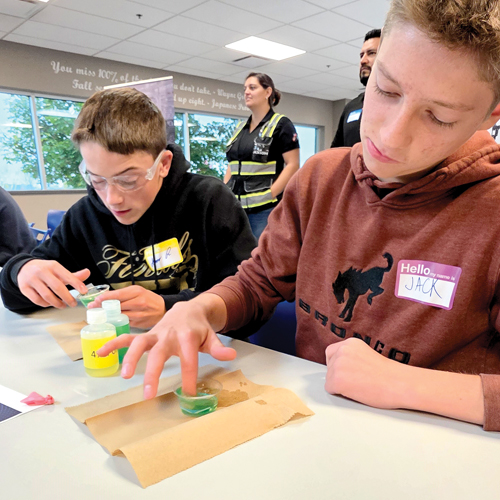
During their visit, students were given hands-on opportunities to experiment with a number of projects, including mixing ingredients for what is commonly known as “slime”.
Capac students Hunter Richardson and Jack Camire enjoyed their experience with the gooey solution so much so that they added extra ingredients and ended up with an impressive amount of the green ooze.
Guests also had a science lesson on how to put a wooden stick through an inflated balloon without popping it. Some were successful, including sophomores Aida Tancredi and Dellah Rodriguez, while other balloons popped around them from failed attempts.
Organizers say the PlastiVanR program is a great way to educate people of all ages about the chemistry, history, processing, manufacturing, applications and sustainability of plastics.
PlastiVanR educators are skilled at tailoring each presentation to meet the needs and grade level expectations of every classroom and teacher through science, engineering, technology and math (STEM).
Axiom Group, founded in 1987, has been a key player in the North American automotive industry for over 30 years.
Starting with a thermoplastic injection molding facility in Aurora, Ontario, Axiom now operates from three international hubs, offering vertically integrated services in product design.
According to company officials, their mission is to deliver top-quality products with exceptional technical support, offering clients the best value in the market.
Axiom and its divisions are industry-recognized, earning multiple “Supplier of the Year” awards from automotive OEMs.
Axiom proudly announced the opening of their AES Facility in Capac in early 2023. This strategic expansion is geared towards providing advanced engineered solutions for the automotive industry, catering specifically to North American vehicle producers and manufacturers.
Plastic injection molding is a versatile manufacturing process where plastic is melted and injected into a custom metal mold to create components. As the plastic cools, it hardens into the mold’s shape, producing precise and complex parts.
This method is highly efficient, cost-effective and widely used, due to its ability to mass-produce quality components with minimal waste.
Related Articles
New Almont Supt. settles in; millage renewal lurks
ALMONT — It didn’t take long for newly selected Almont Superintendent Kyle Wood to jump in…
Goodland Township Supervisor resigns
GOODLAND TWP. — Following months of turmoil at township meetings, including some personal attacks, Township Supervisor Mike Eckardt…
Imlay City DDA discusses Community Center rental rates
IMLAY CITY — Downtown Development Authority members gathered for their July meeting Monday night, covering…