
EGLE says herbicide poison killed trees
Goodland Twp. families/agencies search for culprit(s)
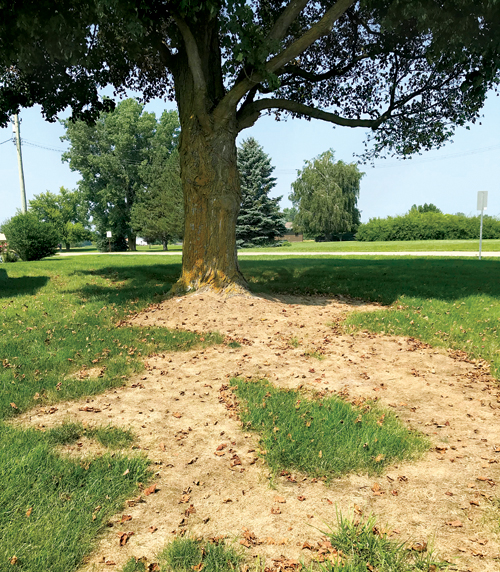
GOODLAND TWP. — The hunches of at least four, possibly five, Goodland Township families came true last week when they received confirmation that a potent fertilizer had been used to kill off trees on their property.
Officials from the Michigan Department of Environment, Great Lakes, and Energy (EGLE) called the families and informed them the fertilizer Spike20P was the herbicide used in the incidents.
Various breeds of trees, including maples and pines over 50 years old, on property owned by Jeff Sklar, Mark Farley, Todd Townley, Mike Eckardt and a fifth unidentified person, were apparently killed off as a result of the herbicide being used around the bases of the trees.
After being contacted about the incidents, EGLE came to investigate each property and took soil samples.
Though they are quick to point out they have no solid evidence or proof as of yet, the residents have their suspicions that someone may be allegedly, and intentionally, responsible for causing the damage to trees on private property.
The issue came to light with a Letter to the Editor in the Tri-City Times on July 30 from township resident Jeff Sklar who is also the former Blight Officer.
His letter was followed up by a visit to the Tri-City Times office by Mark Farley, a neighbor of Sklar’s who lives just down the road.
The two, along with at least two others with the same situation, have been looking into the issue since November of 2024.
One of the other two residents who have also reported damage to trees is Todd Townley, another neighbor of Farley’s. All three men live in the area of Shaw Rd. and Brown City Rd.
The fourth resident impacted by the mysterious chemical is Township Supervisor Mike Ekhardt who lives on Blacks Corners Rd.
One commonality is all four men are involved with Goodland Township politics at some level and they also oppose any development of solar farms.
“It’s all speculation, assumptions and guesses right now,” Farley said recently. “We don’t know if it’s political (from recently elected new board members) or related to our stance on solar farms. We can’t say that right now. We have asked for help with the investigation by several different agencies and we are waiting for test results before we say much more. But, it does make you wonder.”
Both Sklar and Farley have said family members found a crystal like substance sprinkled around the base of trees on private property last fall.
Since then, trees have shown signs of distress and dying leaves as well as dead grass and a path of bare dirt where the mystery chemical has run-off and spread.
Spike® 20P will kill trees and shrubs. Those using the fertilizer are told to carefully read the precautions before using. The active ingredient in the fertilizer is tebuthiuron.
According to packaging labels, Spike® 20P herbicide provides premium, long-term control of the toughest brush species, including big sage, shinnery and other oaks, tarbush and creosote bush, while enhancing grazing and wildlife habitat.
Spike® 20P herbicide may be applied anytime, except when the soil is frozen or is saturated with moisture. For optimum results, applications should be made prior to the resumption of active seasonal growth in the spring or before expected seasonal rainfall.
Instructions say for individual plant treatments, users are to apply Spike® 20P evenly over the area occupied by the target plant(s). They are told not to apply Spike® 20P near desirable plants. Exposure of even a small part of a plant root system to Spike 20P may cause severe plant injury or death.
Environmental hazards say to not apply Spike® 20P herbicide near desirable trees or other woody species. The herbicide is to not be applied directly to water, to areas where surface water is present, or to intertidal areas below the mean high water mark.
Further information about the herbicide shows the product is known to leach through soil into ground water under certain conditions as a result of registered (rangeland and non-crop) uses.
Use of this product in areas where soils have rapid to very rapid permeability, particularly where the water table is shallow, may result in ground water contamination.
Users are told to not apply Spike® 20P in the vicinity of desirable plants. Treated trees and shrubs (brush) exhibit leaf chlorosis and browning followed by defoliation. Woody plants may go through several defoliation cycles before death occurs.
Farley says he has at least three maple trees that are around 50 years old and 60 feet tall that are showing signs of stress and disease, and appear to be dying, he says.
“You can see where the grass has died off. Where the chemical has gone from the base of the tree to run-off and is headed to nearby soybean fields. Who knows how far it will travel.”
The residents have involved law enforcement, a fertilizer company, EGLE and other agencies to help them get answers to their questions.
Sklar says he wanted to bring awareness, “to the ecological destruction situation done to multiple residents of Goodland Township. Multiple township residents appear to be the victims of a tree poisoner. The poison (not yet identified), was thrown down around trees back on Nov. 12, 2024. It was of a white granular substance, as a sample was taken in a sandwich baggie to show to several nurseries in the area for inquiry.”
The men say they have spoken with an arborist and an individual who works with a fertilizer and chemical company in Brown City, searching for answers, and help.
“We are still finding out what we are working with here,” Farley said. “We fully intend to find out who is responsible for this.”
The families have been told they will need to take down the trees and remediate the soil around the damaged area. It was unclear if any of the damage would be covered by insurance nor what the cost of the cleanup might be.
Related Articles

New Almont Supt. settles in; millage renewal lurks
ALMONT — It didn’t take long for newly selected Almont Superintendent Kyle Wood to jump in…
Goodland Township Supervisor resigns
GOODLAND TWP. — Following months of turmoil at township meetings, including some personal attacks, Township Supervisor Mike Eckardt…

Imlay City DDA discusses Community Center rental rates
IMLAY CITY — Downtown Development Authority members gathered for their July meeting Monday night, covering…