
Historic pump organ finds a new home
Family donates relic to Capac Historical Museum
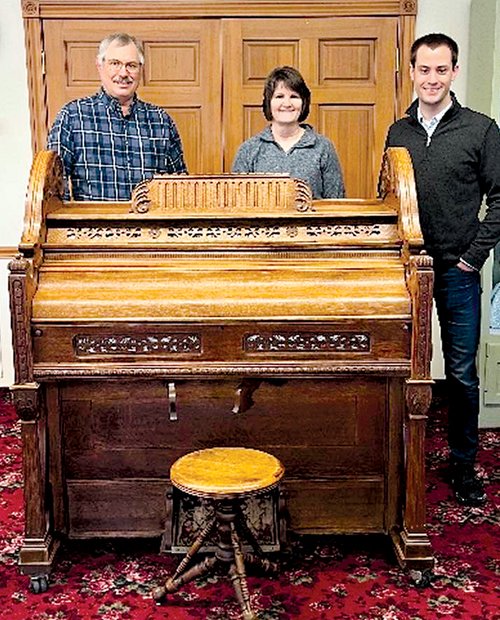
CAPAC — Thanks to a local family who wanted the legacy of music from a different generation to live on, a beautiful, restored pump organ will be available for all to see and enjoy.
A Lynn Twp. family, Gerry, Lori and Joel Opificius, have owned a pump organ that is believed to be over 125 years old.
While they are known as a musical family with Lori and her son Joel being accomplished musicians, the family decided it was time to give the musical instrument a new home and not sell it. They know the value of it’s history is more important than monetary gain.
Lori said the family believes, “it was made in the late 1800s. Right around 1898. I could not pin down (the date) for sure. There was a marking on the inside that said 1900, so that may have been the date.”
When asked to share the story of the historical piece Lori said, “We really don’t know what to write (about it) other than what Bud (Palmateer) wrote. I had asked Bud to write up the history on the organ when he gave it to Joel. He had stored the organ in his garage/barn on Bricker Road, near Yale. He always enjoyed Joel’s piano playing, so (he) asked him to come and play it and ultimately asked him if he would like it.”
In August of 2019, Palmateer wrote, “Mrs. Florence Vincent purchased the organ for the Avoca Elementary school prior to me becoming a teacher there in 1965. I was told the organ was played in the Catholic Church in Brown City.”
Palmateer said the organ became available for sale in 1966 at a cost of $50 and stayed with his family until being donated to the Opificius family in 2019.
Lori, who is in charge of the music ministry at Trinity Missionary Church in Yale said Palmateer had worked hard to maintain the instrument.
“Bud had put a lot of work into the organ and had restored and refinished it,” she stated. “It is a beautiful organ and still plays beautifully. Now, with Joel going into the ministry, it’s not practical for him to be moving it around.”
The family thought about what they wanted to do with the organ, knowing they didn’t want to just sell it.
“ We did not want to give it to someone thinking they might just turn around and sell it someday,” Lori said. “It is a historical piece and it belongs in a museum. That’s when we thought of the Capac Historical Museum.’
Roxann Mills was Joel’s piano teacher and also heads up the Capac museum. Lori said Mills was absolutely thrilled when they contacted her to see if they could donate it to the museum.
“We are very happy it has found a home at the museum and we believe Bud would be happy with this decision also,” Lori stated.
In her research on pump organs, Lori discovered, “Farrand & Votey pump organs, including special parlor or church models from the late 19th century, were primarily constructed from solid walnut. Some models were also made of oak or featured mahogany. These high-quality, hard woods were selected to produce the best musical resonance, often featuring ornate finishes.”
She went on to report, “Primary Wood: Solid walnut is frequently cited for finer, 14-stop, or church-style Farrand & Votey reed organs. Alternative Finishes: Other commonly used hardwoods of that era, such as oak, were used in similar Farrand & Votey models. Construction Quality: As discussed in this Facebook post, these instruments were made of heavy-duty, dense wood to withstand the pressure of internal bellows. Appearance: These organs often featured polished hardwoods, sometimes designed to complement parlor furniture or church interiors.”
Related Articles

New Almont Supt. settles in; millage renewal lurks
ALMONT — It didn’t take long for newly selected Almont Superintendent Kyle Wood to jump in…
Goodland Township Supervisor resigns
GOODLAND TWP. — Following months of turmoil at township meetings, including some personal attacks, Township Supervisor Mike Eckardt…
Imlay City DDA discusses Community Center rental rates
IMLAY CITY — Downtown Development Authority members gathered for their July meeting Monday night, covering…