
Attica man gives the Gift of Life
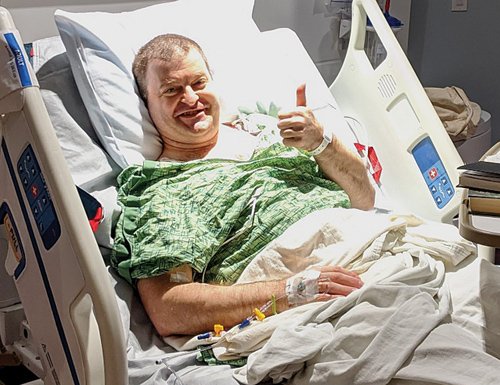
Former IC student donates life; encourages others
Editor’s note: The following story was submitted by Ryan Bodanyi, a former resident of Attica and a former student at Imlay City. He is a 1999 graduate of Imlay City High School and currently lives in Chicago. He shares his story of giving a great Christmas gift. Although he has been gone from the area for several years, he still has ties locally. He writes about his journey in the “first person” format.
Almost exactly two years ago, I gave my spare kidney to a stranger. And I thought I’d explain why, in the hopes that one of your readers might also consider saving a life.
But to really understand why I gave my spare kidney, I need to tell you a bit more about myself.
I grew up in Attica, and attended Imlay City schools. And in so doing, I developed a very strong sense that we should all do what we can to make the world better – not just because we can do so, but because we have a social and moral obligation to do so.
Partly that’s because accepting the suffering of others means that we’re more likely to suffer ourselves as a result. Covid is a great example of this, and there are many others – our own well-being often depends on the well-being of others.
And as a reason to oppose human suffering, that’s more than sufficient. But I also oppose needless suffering because it is ugly, and painful, and morally wrong.
First, the problem. The year before I donated, in 2021, there were 786,000 patients living with kidney failure in the United States, according to the National Institute of Diabetes and Digestive and Kidney Diseases.
In that same year, 139,000 people were on the waiting list for a kidney transplant, according to the Mayo Clinic.
That year, 24,669 patients received a kidney transplant, according to the United Network for Organ Sharing, the non-profit which runs the organ donation system on behalf of the federal government.
So, the obvious problem is too few donations. Some of your readers may even know someone with renal failure. Dialysis can allow those with failing kidneys to live longer than they otherwise might.
But dialysis simply isn’t as good as a functioning kidney. The longer someone is on dialysis, the greater the harm to their long-term life expectancy, even if they eventually receive a donated kidney.
And dialysis can be exhausting. It often requires 3- to 5-hour sessions at a dialysis center three times a week; even if it’s performed at home, it can be just as time-consuming and disruptive to normal life.
With a kidney transplant, all that changes. A recipient might be able to go back to having a normal life.
In 2021, 19,518 transplant recipients received their kidney from a deceased donor. These are people who decided that, should they die, their organs should help someone else live.
You may even be one of these people, if your drivers license lists you as a potential organ donor. In some cases, family members – in the midst of their bereavement – decided that their loss should be used for good.
The other 5,970 donors were living donors, like me. These are people who voluntarily decided to endure surgery – and some manageable inconvenience and pain – in order to save a life.
We can do this because even though we’re born with two kidneys, we can live a long and healthy life with only one. In fact the remaining kidney expands in size to handle the increased burden.
Living kidney donors are still at risk, of course. Cancer, or a car accident, or a very precise alligator bite could still damage their remaining kidney. Those risks are miniscule, partly because alligators often aren’t that precise. But what happens then?
The answer is simple: living kidney donors will almost invariably receive a new kidney from the transplant list.
That’s because they’re rushed to the front of the kidney transplant line. Indeed, as a living donor, I was given the opportunity to identify three other friends or relatives who’d also be rushed to the front of the line, if they ever need a kidney transplant.
The rationale here is also simple: if the living donors hadn’t given their spare kidney away, they might not need a transplant. They’re also forgoing the opportunity to give their spare kidney to a dear friend or relative, should they ever need one.
By addressing these concerns, the national kidney donation system makes it more likely that people will consider donating their spare kidney, like I did.
This matters because the shortage of donors means that too many people are suffering and dying from kidney failure in the United States.
But it also matters because kidneys from living donors tend to last longer than kidneys from deceased donors – an extra five years, on average.
Most living kidney donors know the person they’re donating to; that’s why they give. Only a subset give to strangers they’ve never met: 429 in 2021, the year before I did so.
Such donations are called “altruistic” or “non-directed” – and they can lead to something special: a chain donation (though mine did not).
This can occur when a friend or family member of the kidney recipient isn’t able to give them their own kidney, perhaps because of a blood type mismatch. But because their loved one is receiving a kidney from a stranger, they’ll donate their own kidney to someone other than their loved one.
Chains can be long or short, but when they exist, they can dramatically magnify the impact of a single donation, helping to save or extend many lives.
All that helps to explain why I’ve spent my career trying to make the world better in my small way, by fighting climate change, and air and water pollution that sickens and kills people.
And yet! About two decades ago I heard that the friend of a friend needed a kidney donation. I didn’t get tested to see if I might match, because I worried that we might actually match – and then I’d feel morally obligated to save her life, and endure pain, and stress, and risk on her behalf. But I didn’t want to go through all that for a stranger. I was afraid.
As the years passed, that decision gnawed at me. I wasn’t living up to my own ideals. And to be clear, I often fail to do so; living a moral life often entails a painful awareness of one’s own shortcomings.
I eat meat from animals that needlessly suffered before they were slaughtered. I’ve spent money for my own pleasure and enjoyment instead of using that same money to help people in desperate need.
And yet, this felt more grave: I held a life in my hands. I didn’t know their name, but I still felt the contradiction between who I wanted to be, and the decision I’d made.
Over the course of two decades, it weighed on me.
So I began to research kidney donation. What was it actually like to donate? What kind of pain or risk would I actually experience?
That research told me that I was worrying too much – some donors spend only a day in the hospital; the risk of complications was miniscule; yes, there would be discomfort and inconvenience, but not as much as I worried there might be.
And so I went through the screening process. This involved a battery of physical tests, for obvious reasons – they wanted to make sure my kidney was healthy, but they also wanted to make sure that I could live a long and healthy life without it. I also passed a psychological screening. And then Covid upended everything.
By the time everything settled down, years had passed, and I no longer lived in San Diego, where I’d gone through the screening process.
But through that screening process, I’d gotten to know the doctors there, and I felt comfortable with them. I didn’t want to donate somewhere new.
Fortunately, the National Kidney Registry offers funding for situations just like this: up to $5,000 to reimburse travel and lodging costs, and even funding for a friend or family member to join me if I wanted.
So my Dad and I flew out together. I asked him to come because we both love to walk – we’ll sometimes walk 5-6 miles down our gravel country road, just because. And one of the things that I learned in my research is that walking is one of the best ways to recover from the surgery.
My dad was there when I woke up after the surgery, and that was nice. But what I really wanted was to leave the hospital as soon as possible.
I wanted to be one of the fortunate few who were granted release after a single day. Because who likes being a hospital patient?
So as soon as I could, I started walking in circles around the hospital ward. I spent an hour that afternoon doing so, and another two hours that evening.
I was exhausted, but I also knew that doing so would help me pass the medical markers necessary for my release.
Indeed, that effort is why I only spent a single night in the hospital. Then I went back to our Airbnb and slept for something like 14 hours.
Every day for the rest of the week, Dad and I walked all over the place.
Neighborhoods and places I’d never had the chance to explore when I lived there. And I introduced him to places that I knew and loved.
And then about a week later I had my follow-up appointment, which confirmed that I was doing well, and could go back home to Michigan.
A few notes before I finish.
First, pain. It was noticeable and occasionally bothersome for the first day. After that it diminished quickly. Within 3 days the only thing I was taking was acetaminophen. And then after a week and a half I was forgetting to take that every day, and so I stopped.
Second, life changes. I was told that moving forward, I should really try to avoid any type of pain medication other than acetaminophen.
Ibuprofen works best for me and so that’s a change I’ve sometimes regretted. I was also told that I shouldn’t take protein powder, but since I never did, that’s never been an issue.
In no other way has my diet or behavior really changed. The follow-up tests I’ve had have shown that my kidney function is very good. My numbers aren’t as great as when I had two kidneys, but still very healthy.
Finally, my recipient. When I gave, I was told that I might never know who the recipient was. And that was okay with me. But as it happens, they did reach out. We’ve since exchanged a few messages, but we haven’t yet met, and it doesn’t seem like we will.
But even so, the guy who got my kidney now gets to live a much better life. He can work, which he couldn’t before. His five kids still have a dad. He and his wife seem to be very much in love, and they’re still together because he’s still alive.
All my life, I’ve wanted to live in a better world – a world with less suffering, more understanding, and more justice. I hope that you do, too.
It takes time and effort, but I believe that we can build that better world; that what we do can impact the people around us, for the better.
I know this is true because I’ve spent my career doing so – and because as an organizer, I’ve helped other people do so.
And as I’ve gotten older and more mature, I’ve come to feel more deeply that love and understanding and tolerance – caring about the person next to you – is what gives life meaning, and that it both represents and enables the very best in us.
I felt compelled to live up to my own ideals and save the life of a stranger. But even so, it took me 20 years to do so. My hope is that you’ll consider joining me, even if it also takes you two decades.
If surgery makes you squeamish, or if you can’t take the time off work, that’s okay – donating an organ isn’t the only way to save a life, or lessen human suffering.
You can help feed the hungry, and give shelter to the homeless. Cure diseases, and raise kind and compassionate children.
With your time and effort, your money, or your vote, you can do your small part to address big, complex problems. Or you can focus your efforts within your own family, or community.
In this season of generosity and reflection, I hope you’ll consider doing what you can to make the world just a bit brighter for all of us.
Related Articles

Eastern Michigan State Fair opens gates Tuesday
IMLAY CITY — The annual Eastern Michigan State Fair is putting the finishing touches on the grounds and buildings, getting them in prime shape prior to gates opening on the 2026 fair.
Main Street work in Capac to begin
CAPAC — For motorists who routinely drive through Capac to go to work or to Metro Detroit, you might want to find an alternate route.

Two Imlay City businesses closing
IMLAY CITY — Two Imlay City businesses have announced they will be closing their doors in the coming weeks.