
Every day is Groundhog Day in Goodland Twp. backyard
Sue and Joe Sam’s research project
gains traction in scientific community
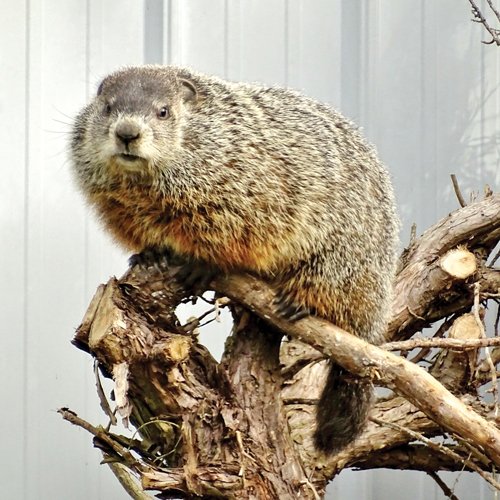
GOODLAND TWP. — If Punxsutawney Phil made his burrow in the Great Lakes State, chances are he’d stay deep in the ground this Monday—given the frigid winter weather of late.
Still, on Groundhog Day (Feb. 2), people across the Midwest eagerly await the animal’s prediction of six more weeks of winter or an early spring.
For longtime residents and backyard researchers Sue and Joe Sam, groundhogs are remarkable for so much more than that.
Since 2003, the pair has delved into the world of the burrowing marmots, learning about their behavior along the way. Today, their backyard project has transformed into ‘Woodchuck Wonderland,’ spawning a website, children’s books, numerous newspaper articles and validation from the scientific community. They had no idea what they were getting into.
Love at first sight?
It started out simply enough, Sue says. A groundhog emerged in their yard, and the Sams didn’t know what to make of it.
“When our first groundhog, ‘Wilhelmina,’ arrived, I was ignorant about the animal,” Sue says. “Joe said he’d heard they were destructive and would eat all our flowers and destroy the foundation of our home.”
Admittedly, Sue says, that didn’t sound good. After researching online and at Dryden’s Seven Ponds Nature Center, Sue still wasn’t sure if Joe’s assertion was true.
“We decided to watch them for a while, never imagining that we would still be watching in 2026,” Sue says.
And watch they did. Without a feeding station, just a birdbath, the Sams observed woodchucks in their natural habitat. A gifted artist and wildlife photographer, Sue also documented their findings both on paper and through pictures and videos. She says they’ve learned that contrary to popular belief, woodchucks are not just pests with which humans are unable to coexist.
Yes, she adds, they’re known to eat plants and flowers, but the familial nature and behavior of woodchucks is both fascinating and surprising.
An ‘open burrow’
Over the years the Sams have identified and named dozens of woodchucks. Just like some of their human counterparts, the Sams observed that the animals are not monogamous, as earlier believed.
Sue says some research of Alpine marmots indicated that females may mate with more than one male and produce litters with multiple fathers.
Still, like some of their human counterparts, some woodchucks prefer to stick with their original partner, Sue adds.
“We’ve documented males returning year after year to the same female, patrolling territory, marking and maintaining burrows,” she says. “In some cases, males also interact closely with juveniles, behavior that suggests a more complex social role than previously assumed.”
All in the Family
Again, like their human counterparts, Sue says male woodchucks do more than just patrol and maintain burrows. They’ve observed Woodchuck Wonderland males interact with their youngsters, and more. They’ve documented their findings in their 2022 publication called ‘A Most Unusual Woodchuck Story.’ It was their second book, the first— ‘The Amazing Groundhogs of Woodchuck Wonderland’ came out in 2018. Both are available on Amazon.
From skepticism to science
While some of the Sams’ early observations of the Woodchuck Wonderland chucks were doubted by academic researchers and scientists, their continued surveillance and unbiased findings endured.
The Sams’ work has been cited by leading marmot researcher Daniel T. Blumstein of UCLA, recommended by biologist Roberta Gibson of ‘Growing with Science,’ covered in the New York Times, Tri-City Times and other local publications, featured in Nautilus magazine, and selected for use by ‘Humane World,’ a publication of the Humane Society, now known as Humane World for Animals. Sue has also presented their findings to groups ranging from school kids to senior citizens.
Validation from the scientific community is meaningful, she says, adding that they’ve made lasting friendships along the way.
“It is gratifying to know that our long-term observations are valued by the scientific community and that we’ve been able to contribute to the natural history of woodchucks,” she says. “We especially appreciate the thoughtful discussions we’ve had with marmot researchers over the years.”
The great reveal
While the Wood-chuck Wonderland groundhogs may choose to stay put in their burrows on Monday, the Sams plan to bring them into the light with their newly updated website, www.woodchuckwonderland.com.
Sue has been working overtime to get the revamped site up and running in time for this year’s Groundhog Day. The Sams hope people will continue to learn more about the widely misunderstood creatures they’ve grown to appreciate.
“Unlike short-term wildlife encounters, our work is based on continuity and familiarity—allowing rare glimpses of behaviors that are difficult to observe in brief field visits,” Sue says. “We hope that our observations provide meaningful insight and increased tolerance of woodchucks. Coexisting is possible.”
For more information, visit woodchuckwonderland.com. Sue’s stunning wildlife photos can also be viewed at https://susan-sam.pixels.com.