Veteran returns home to Almont Township after war
In last week’s issue of the Tri-City Times, we shared Part 1 of the story of veteran Joe Treadgold as shared by Lynn Nolin with the Almont Historical Society. Below is Part 2 of the story.
In 1913, William Joseph was born in the old farmhouse on Shoemaker Road, becoming the first Treadgold born in the United States. Billy was doted on by his parents and his beloved uncle, Jess. Joe raised wheat, oats, corn and hogs, as well as a few dairy cows and workhorses, while Amy raised chickens.
Together, they sold and traded eggs, cream, and crops in Almont, Imlay City, and Detroit’s Eastern Market. Like many local farmers, Joe regularly supplied hogs to Mr. Terry’s Meat Market in downtown Almont, and a milkman collected their milk cans for delivery to the processing plant. Life was bountiful and busy.
Life continued steadily until an assassin’s bullet on June 28, 1914, set a chain of events in motion. The assassination of Austro-Hungarian Archduke Franz Ferdinand helped ignite a world war and altered the course of Joe and Jess’s dreams.
Europe’s growing conflict still seemed distant from Joe’s 40-acre farm in Almont Township, bordered by the Schultz and Ferguson farms and surrounded by families of German, English and Scottish descent. Jess was following Joe’s path toward farm ownership but had left his sweetheart, Dot, in Staverton.
She worked as a barmaid at the Crown Pub, owned by his parents, William and Catherine Treadgold, who lived upstairs with his teenage sister, Kathleen. From his small room at “Old Forty,” Jess faithfully wrote to them and described threshing bees, church socials and gatherings at Muir’s Pond, assuring Dot that she would fit in.
After five years in America, he wanted to remain, raise a family, and build a life among neighbors who shared his ambitions and work ethic. When war erupted in Europe that summer, Kathleen reported that their mother had died, casting a shadow over Old Forty. That autumn, the United States remained neutral, with President Wilson declaring the nation “impartial in thought as well as in action.”
Jesse’s Choice, September 1916
To the farmers along Shoemaker Road, Europe’s nations seemed to be bleeding one another dry while their adopted country remained neutral. Britain was losing a generation of men. The Battle of the Somme, fought from July to November 1916, caused more than 1 million casualties, including 300,000 deaths. That year, Britain introduced compulsory military service for single men ages 19 to 40.
Although Jess had been away from Britain for five years and was nearing farm ownership and marriage, he felt compelled to speak with Joe. Neither brother was a naturalized American citizen yet, and both still considered themselves British nationals with a duty to defend both their native and adopted countries. Even though the U.S. had not entered the war, Jess was ready to act. At Thanksgiving, he insisted on returning to England to enlist. Joe had a wife, child and farm to support, while Jess felt an urgent need to see their father and sister after their mother’s death.
If possible, he hoped to persuade them to immigrate to America and join Joe’s family in Almont. He also planned to marry Dot so that, if he were killed, she would receive his war pension and have an opportunity to come to America. The brothers reluctantly agreed on their roles in the conflict. Jess packed a few clothes and a blanket, tucked his savings into his heavy coat, and left the rest of his belongings behind.
He placed his shaving mug and razor strop on the shelf beside Joe’s and promised his young nephew Billy that he would return. Retracing his 1909 journey, Jess crossed the same vast ocean that had once carried him toward prosperity, liberty and a new life — this time toward uncertainty, restriction and war.
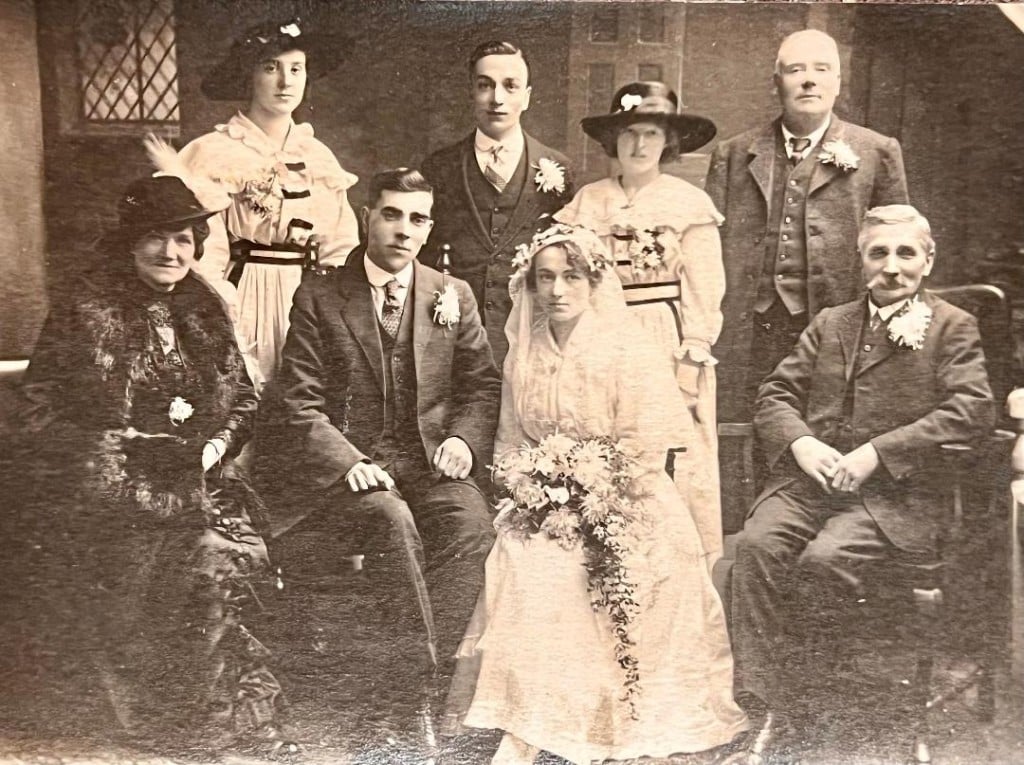
Jess arrived in England on Dec. 17, 1916. At last, he reunited with his aging father, William, and his 18-year-old sister, Kathleen, now a young woman with a soldier beau of her own. She had been only 11 when he last saw her. After unpacking, he went downstairs to the pub to greet his fiancée, Dot. The couple quickly arranged their wedding, and on a cold day in January 1917, Jesse Page Treadgold married Dorothy Eliza Rogers. Soon afterward, he entered the British Army’s Machine Gun Corps, where the grim odds already loomed: 1 in 3 soldiers would be wounded or killed, earning the unit the ominous nickname “the Suicide Club.”
Almont, November/December 1917
Joe came in from the damp cold as winter closed in on the farm, and Amy had supper ready. A year had passed since Jess left for England. Nearly 4, Billy barely remembered his uncle, but he listened attentively when his father read Jess’s letters aloud. He knew Jesse was far away, that he now had an Aunt Dot, and that the “stork” would soon visit them. Imagining the stork as one of the sandhill cranes at the pond, Billy could not understand why the news made his mother cry out with joy. But he knew he would see Uncle Jess again for he closed his last letter with “…tell Billie Uncle Jess is coming back someday. Love to all from your loving bro Jess xxxxxx for Billie.”
By late November, farm work had slowed to solitary chores: mending fences, sharpening tools and feeding livestock. Trips to the Eastern Market became less frequent. As Christmas approached, Billy would help his mother string popcorn and berries into garlands for a small pine tree Joe cut from the back field. Their simple celebrations centered on church services, neighborhood gatherings and a shared meal. Billy might find a penny, an orange, candy from Bowman’s Drugstore, new knickers and perhaps a toy in his stocking. Farm life allowed few luxuries, but Christmas remained a joyful occasion.
Shortly after Thanksgiving, the family gathered around their one luxury: a wooden tabletop radio with a steeple-shaped top and large knobs. Joe could tune in a man speaking from faraway Detroit, along with comedy sketches and plays. Most often, however, he listened to grim war reports. At times, the news was so disturbing that Amy sent Billy to bed before the broadcast ended. One evening, as the family listened to a comedy program, a crash sounded from the kitchen. Through the open doorway, Joe saw shards of china scattered across the floor. Turning pale, he said, “Something has happened to Jess.” Jess’s shaving mug lay broken, though nothing else on the shelf had moved. Years later, Amy recalled that a cold wind seemed to pass through the house. The adults understood with heavy hearts. Weeks later, a letter confirmed that Jesse Page Treadgold had been killed in action near Ypres, Flanders, Belgium, on Nov. 24, 1917.
March 1919, a return to England. Joe, Amy and Billy Treadgold, c. 1918
In March 1919, Joe Treadgold sold the farm he had struggled to build and entrusted the family’s furniture and belongings to neighbors. With Amy and Billy beside him, he returned to Staverton to settle his parents’ estate. His father had died only weeks earlier, in February, and the family pub now had to be sold. Joe also faced a more painful journey: visiting his brother’s grave in Belgium. He hoped that, once the estate was settled, he could persuade his sister Kathleen and Aunt Rhoda to leave war-ravaged England and begin again with his family in Almont. Food was scarce, the economy was broken, and thousands were once more looking across the Atlantic for hope. But Kathleen, whose fiancé had also been killed in the war, chose to remain. She later married a local soldier who had survived the conflict and lived in Staverton until her death in 1990 at age 92. Her descendants still live in the ancient village.
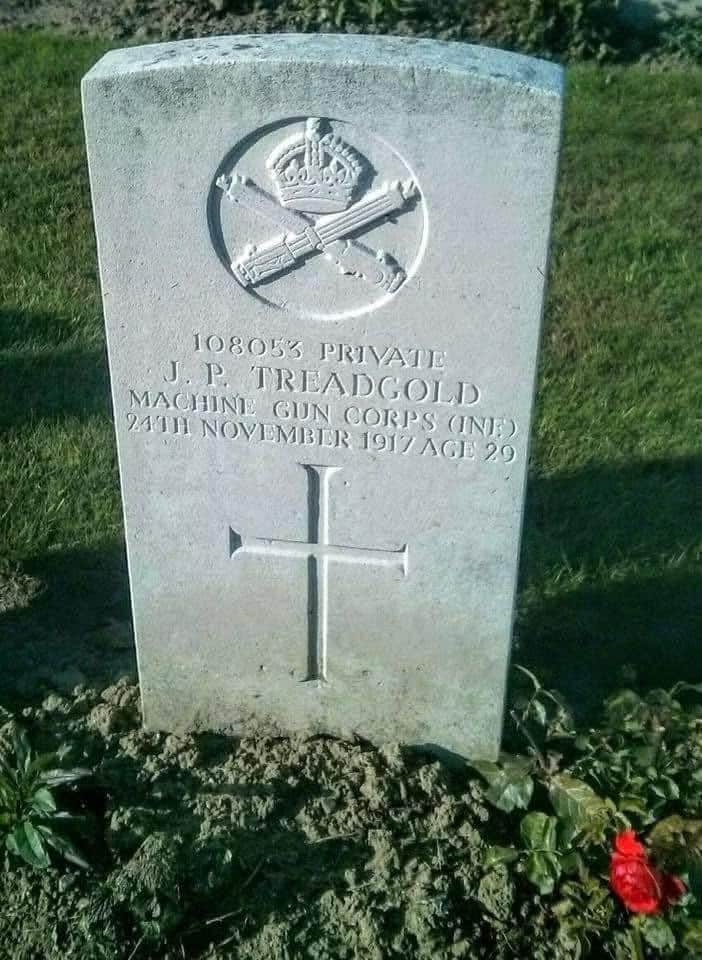
Joe and his family remained in England for nearly two years. During that time, my mother, Barbara, was born in the rooms above the family pub on Aug. 26, 1920 — a new life beginning in the shadow of so much loss. Later, Joe traveled alone to the military cemetery where Jess had been reinterred. Before him stretched endless rows of white headstones, each marking a life cut short. Gripping the cemetery map, he searched beneath the fierce sun until the heat and glare forced him to stop. As he steadied himself, his hand brushed a stone. He looked down and found the brother he had crossed an ocean to mourn: “108053 Private J.P. Treadgold, Machine Gun Corps (Inf.), 24th November 1917, age 29.”
Joe and Jess were finally reunited. Joe kept his thoughts at that moment private. He shared Jess’ letters, the story of the broken shaving mug and the moment of the discovery of the gravestone. However, the grief he experienced after finding it remained personal.
Epilogue: Joe and his family, including his Aunt Rhoda, returned to Almont in March 1921 and bought an 80-acre farm on Muir Road, nearly parallel to his first farm. They reclaimed their belongings from neighbors who had become family. England was no longer home; Almont was. Joe died suddenly in 1947 while harvesting corn on the farm. Amy and their youngest daughter, Jessie Scully, continued farming until Amy’s death in 1974. Billy became a UAW organizer and worked for Hurd Lock. He married Jo Hannan, and they had three daughters. Barbara, my mother, married Don Nolin, a World War II veteran from Imlay City, and they raised six children, some of whom still live in the area. Jessie married and later divorced Oliver Scully; they had one son, William.
October 2014
Richard Treadgold, son of Jesse Robert — who was born two months after his father was killed — visited Almont. It was the long-awaited reunion of two family lines, dreamed of since the Treadgold brothers parted at the train station in 1916. Born in a small village, the brothers shared a dream and followed the path of immigration together for a time. Though buried in different nations, an ocean apart, their bloodlines were reunited.
Author